


latest news

One of the focal points when designing your new stable space are the dimensions of your stables themselves. There are many factors than can influence your decision-making process, and it’s important to consider each one carefully before signing off. Monarch stables are built to stand the test of time, so you need to make sure that whatever stable size you opt for is going to suit all your needs going forward.
Whilst some of you may be governed somewhat by building constraints or existing infrastructure, there are plenty of bespoke stable options that can bring your dreams to reality. Whether you’re housing shiny showjumpers, heavy horses, or Shetland ponies there is the perfect fit for each one, as well as their dedicated owners and grooms.
Here are some useful dimensions to consider when drawing up your stable plan:
• The ‘standard’ stable size for horses is 12ft x 12ft
• Large horses or heavy horses require a minimum of 12ft x14ft
• Pony stables range around 10ft x 10ft – 10ft x 12ft
• Foaling boxes should allow for a minimum of 14ft x 14ft
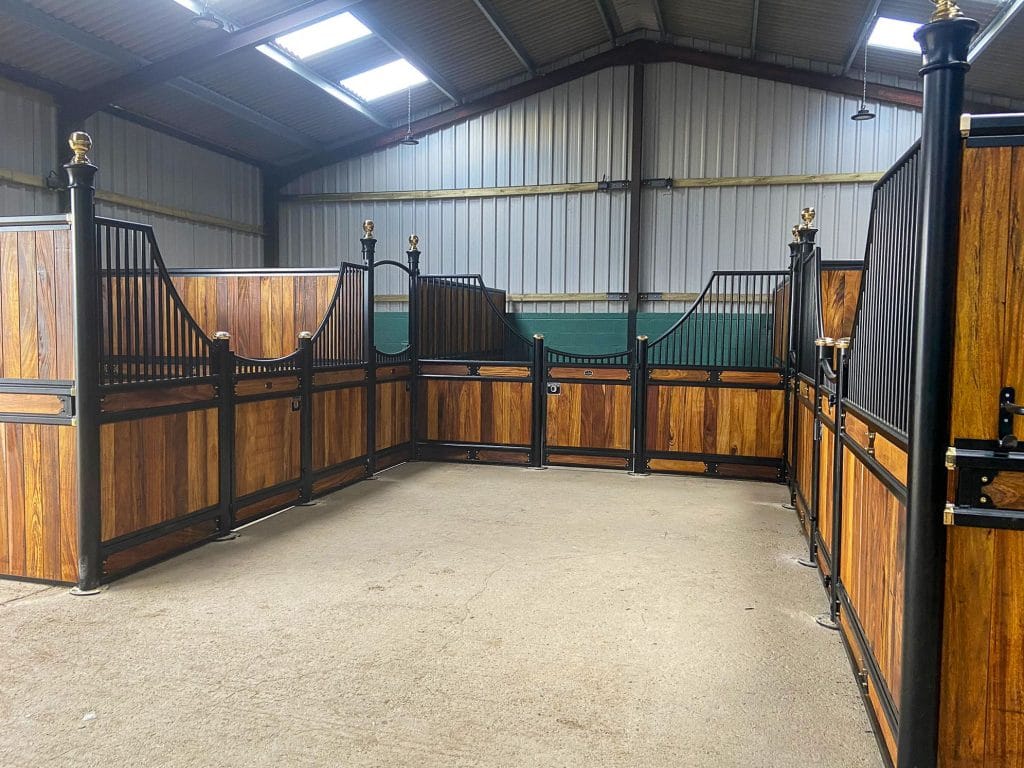
Size matters
The first port of call when mapping out your stables is to consider the space you are working with and the types of horses you have. If you are restricted by the barn or building space, you may find yourself limited on the number or size of stables. From here you should consider the types of horses you have in and decide whether it is size or number you’re willing compromise on.
Our standard stable sizing is 12ft x 12ft, which provides horses with ample space to move, lie down, and roll comfortably. However, some of our ranges, such as the Imperial Range, are available as 10ft, 12ft, or 14ft, as well as bespoke sizing to suit your needs.
Large horses or heavy horses will automatically require larger stables. Having stables that are too small for the horses in them can lead to distress and accidents when a horse either can’t lie down or roll properly or ends up stuck whilst doing so.
If breeding is your thing, large stables are a must-have to allow for comfortable and safe foaling boxes for the mares and foals. The size of a stable used for foaling is important to allow the mare the opportunity to move and get comfortable, and as well as the safety of the foal to avoid accidents like getting stepped on whilst they are small and wobbly. It also allows for handlers and vets to safely step in and lend a hand if necessary.
If you’re in business of rehabbing or perhaps don’t have access to turnout in the winter months, then larger stables are exactly what you need. For horses who are returning from an injury on box rest, a larger stable for them to move around in can help to reduce the negative side effects of boredom such as cribbing or box walking. The same goes for horses stabled during the winter, the larger stable will facilitate movement and help to reduce stiffness from being stabled day to day.
Floor plan
There are other factors that come into play when picking dimensions that cannot be overlooked to guarantee a seamless design. Your horses’ needs should be at the forefront, and these a close second!
The shape and structure of your building, whether that’s an internal or external space, can affect the dimensions and positioning of your stable plan. Details like ventilation (for barns) require careful consideration to ensure the space is suitably set up to house your horses for many years to come. Whilst aspects like ventilation and water supply do not directly hinder your stable dimensions, they can have a significant influence over the floor plan which ultimately might alter your original ideas. That said, with a totally bespoke approach and personal touch, your dream stables can become a reality for whatever space we’re working with.
Height and width
It’s not just the size of the stable itself that requires some deliberation. Depending on the design you’re going for, height can be an influential factor coming into play that you might have overlooked. If you’re planning on having header bars, then ensuring there is ample headroom is a must.
Once again, this decision is predominately overseen by the size of the horses, infrastructure, and personal preference. The standard height of our doors is 7.4ft or 22 hands in horse height, which allows for some pretty tall horses to fit comfortably underneath. In some instances, people might choose not to have any header bars above their horses’ stables and opt for a swan neck front. Where header bars are necessary for structural integrity, there is the option for an arched design to allow for even more headroom.
The width of your doorways is something else you might have missed but can be an influential part of your perfect set up. We have all heard the odd horror story where a horse has caught their side on a stable door, so the size of your doorways is just as important as the size of your stables! Again, if you have large horses, mares in foal, and even mares with a foal at foot, you’re going to want to leave extra room for the doorway. Our stable doors are available individually in standard sizing, or totally customisable to suit your horses’ and your business needs.
We understand that designing the perfect floor plan and bringing your vision to life is a big investment and a very personal journey, because we’ve done it time and time again. We’ve helped so many stables across the globe turn their dreams into reality and pioneered some amazing new concepts and designs. The options are endless when it comes to bespoke stables, so make sure to get in touch with your ideas, however big or small, and our design team will be on hand to guide you through the process to see your ideas come into fruition.